Bolton based · North West & UK-wide · Free site surveys01204 913961WhatsAppsales@filtrationengineersltd.com

Accredited, insured & site-safety trained

CHAS accredited contractorSafeContractor approvedCCNSG Client Contractor National Safety Group passportIPAF trained operatorsPASMA tower trained

Whenever engines are run indoors, exhaust fumes build up quickly in the workshop. Filtration Engineers Ltd design and install vehicle exhaust extraction systems that capture the fumes directly from the tailpipe and discharge them safely outside – protecting your technicians and helping you meet your duties under COSHH.

With over 25 years of industry experience in extraction and filtration, we survey your workshop, the vehicles you work on and how the bays are used, then supply and fit the right system – from a single hose reel on an MOT bay to a full rail system for a bus or HGV depot.

FEL offer FREE site surveys, if you would like a quotation on a new exhaust extraction system, repairs to an existing one or LEV testing, get in touch and see what Filtration Engineers Ltd can do for you.

Vehicle exhaust extraction systems we install

  • Hose reels – spring or motorised
  • Overhead rail / track systems
  • Fixed & semi-flexible drops
  • Articulating boom arms
  • Underfloor & in-pit extraction
  • Tailpipe nozzles, including high-temperature
  • Self-releasing nozzles for drive-out bays
  • Extraction fans, ducting & automatic start / stop controls
  • Replacement exhaust extraction hoses
  • LEV testing to COSHH regulation 9
Why Vehicle Exhaust Extraction?

Diesel engine exhaust emissions are classed as a known cause of cancer, and petrol engines produce carbon monoxide, which is poisonous. Breathing exhaust fumes in a workshop can cause irritation, coughing and breathlessness in the short term and more serious lung disease over time.

HSE guidance for motor vehicle repair and for diesel exhaust (HSG261 and HSG187) recommends removing the fumes at source with tailpipe extraction wherever engines are run indoors – general ventilation alone rarely keeps levels low enough.

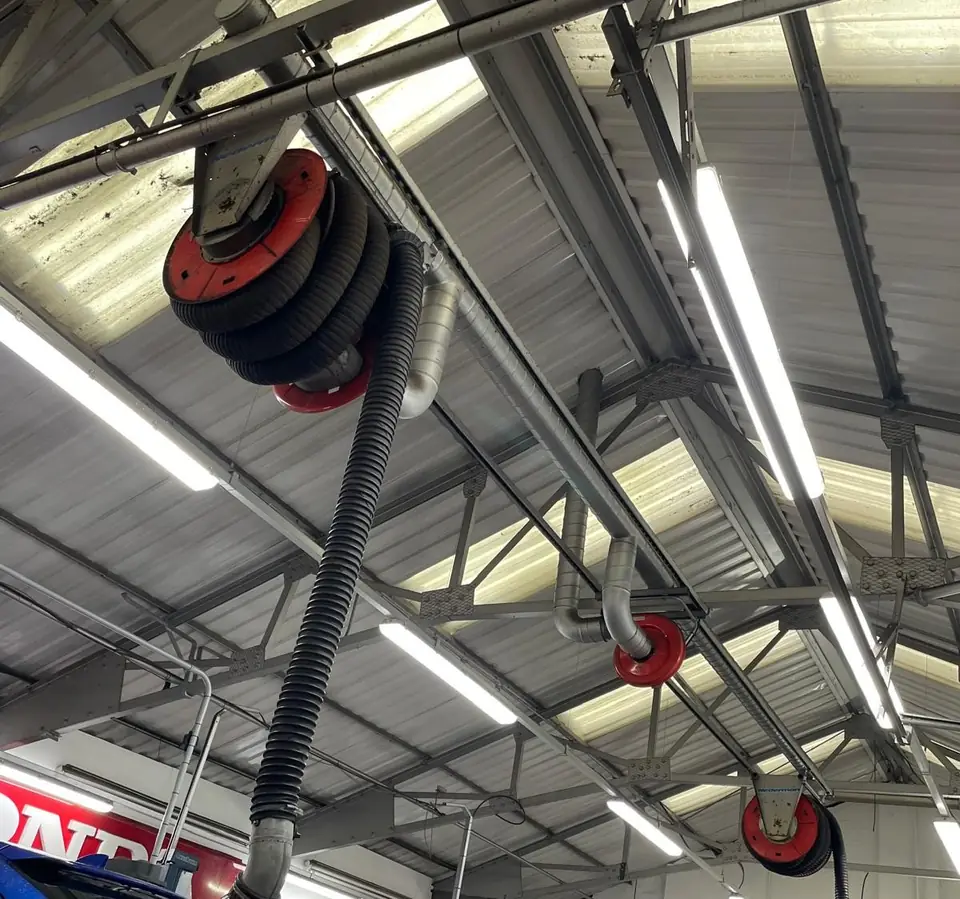
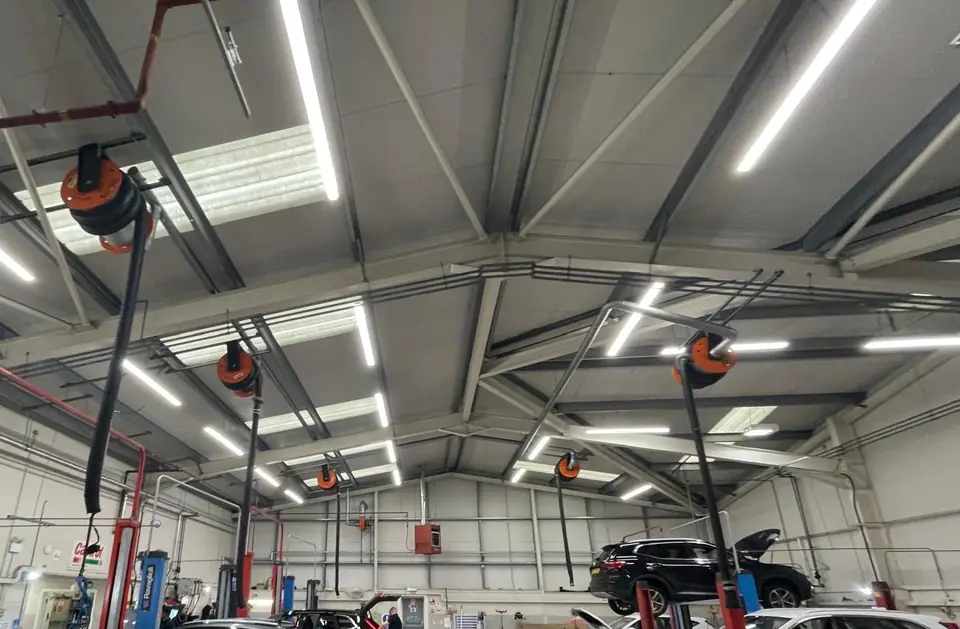
Overhead exhaust extraction hose reels in a vehicle workshop

Where Are They Used?

Car, van and motorcycle garages, MOT testing stations, vehicle dealerships and body shops; HGV, bus, coach and fleet workshops; agricultural and plant workshops; fire, ambulance and police vehicle stations; and vehicle manufacturing and test facilities.

Each system is matched to the vehicles – from small cars to HGVs with vertical exhaust stacks – and to how the bays are used, so the hose is always within reach and out of the way when it isn’t needed.

Vehicle exhaust extraction hose reels above the service bays of a garage workshop

Maintenance & LEV Testing

Exhaust extraction is local exhaust ventilation (LEV), so it must be thoroughly examined and tested at least once every 14 months. Hoses crack and get run over, nozzles wear and fans lose performance, so regular checks keep the system working.

We service and repair existing systems, replace hoses, nozzles, reels and fans, and provide the LEV test records your insurer and HSE will ask to see.

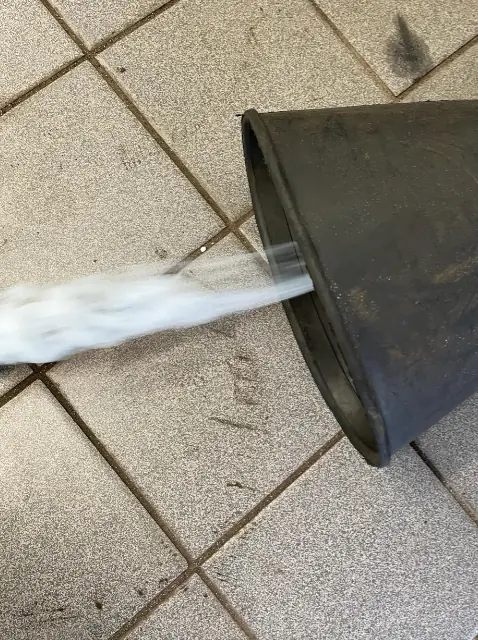
Smoke test of a vehicle exhaust extraction nozzle during LEV testing
FAQs

Vehicle exhaust extraction FAQs

Do I need vehicle exhaust extraction in my workshop?

If engines are run indoors – for diagnostics, MOT and emissions tests, tuning, or simply driving vehicles in and out – you need to control the exhaust fumes. Diesel engine exhaust is classed as a known cause of cancer (IARC Group 1) and petrol exhaust contains poisonous carbon monoxide. Under COSHH employers must prevent or adequately control exposure, and HSE guidance (HSG187) recommends capturing the fumes at the tailpipe. Opening the doors or relying on catalytic converters is not enough.

Does vehicle exhaust extraction need LEV testing?

Yes. A vehicle exhaust extraction system is a local exhaust ventilation (LEV) system, so COSHH regulation 9 requires a thorough examination and test at least once every 14 months, with records kept for five years. We can test your existing system as well as install new ones.

Which type of exhaust extraction system is best?

It depends on the vehicles and the layout of the workshop. Hose reels suit fixed bays, overhead rail systems suit long bays and drive-through workshops, fixed drops are a simple low-cost option, and underfloor systems keep the floor and ceiling clear. We’ll recommend the right system during a free site survey.

Can you extract from HGVs, buses and emergency vehicles?

Yes – larger hoses, high-temperature nozzles and vertical-stack nozzles are available for HGVs, buses and plant, and rail systems with self-releasing nozzles let fire engines and ambulances drive straight out with the hose still attached until it pulls free.

Can you service or repair an existing system?

Yes. We replace split or crushed hoses, worn nozzles, faulty reels, fans and controls on existing systems, whoever installed them, and carry out the 14-monthly LEV test.

More filtration FAQs

Simple process

How we work

From the first phone call to the finished job, you deal with one specialist team.

  1. Free site survey

    An engineer visits, inspects your AHU, LEV or dust collector and talks through what you need.

  2. Clear quotation

    You get a written report and a fixed quotation – filter contract, remedial works or new system.

  3. Work carried out

    Scheduled around your production, with RAMS provided and site rules followed by our own engineers.

  4. Ongoing support

    Service records, filter-change reminders and planned maintenance to keep you compliant.

Areas we cover

Vehicle Exhaust Extraction North West & Nationwide

Our home patch is the North West – Greater Manchester, Lancashire, Cheshire, Merseyside and Cumbria – and as a specialist industrial service we regularly travel to sites right across the UK.

Based in Bolton, Greater Manchester we cover the North West including Bolton, Manchester, Salford, Wigan, Stockport, Warrington, Liverpool, Blackburn, Preston, Lancaster, Carlisle & Chester; the Midlands including Birmingham, Coventry, Derby, Nottingham, Wolverhampton, Worcester & Hereford; the South including London, Bath, Bristol, Cambridge, Exeter, Norwich, Oxford, Peterborough, Plymouth, Portsmouth, Poole, St Albans, Wells & Winchester; the North East including Durham & Sunderland; and Yorkshire including Bradford, Leeds, Sheffield & York. Please contact us if your area is not mentioned.

Get a free, no-obligation site survey

Filter change contracts, LEV testing, remedial works or a brand new system – talk to an engineer today.

WhatsApp us